CMDR dcode profiel > Logboek

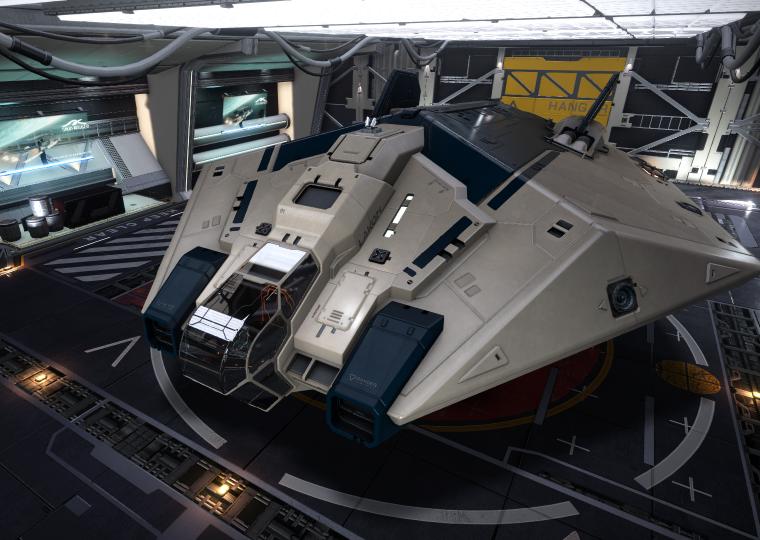
(Asp Explorer)
This week was a blur of high-speed transit. I’ve been leaning on the neutron highway to keep pace with the fleet, using the white-blue jets to sling my ship toward Waypoint 2. It’s a faster way to travel, but it leaves less room for the quiet moments. I still pull over when the sensors catch a hint of life—a few first footfalls, a few biological samples—but mostly, I’ve been watching the galaxy move past my canopy. The photos I take are just shadows of the real thing; out here, you don't just see the view, you feel the scale of it.


The "Black" nearly claimed me three times this week. Inattention is the real killer out here. I fumbled the controls exiting witch space and nearly flew straight into a star’s heart. Later, I boosted toward the Viruna black hole with more momentum than I could shed. Both times, the emergency drop saved me.


But the planet surface at the Waypoint 2 gathering was the closest call. I misjudged my speed as I approached the surface and bounced the ship off the terrain like a skipped stone. I limped to the carrier with 26% hull integrity. If it weren't for the Pillar of Chista being stationed nearby for repairs, my journey would have ended in a cloud of debris.
Data is turned in. Hull is patched. I’m currently camped at the gathering point on Thuecheae WR-H d11-54 (13 b), watching the Seldowitch Nebula hang in the sky.

The next destination was revealed today: Beagle Point. We are heading where the stars thin out and the light dies. On DW2, I reached the edge just as the party was ending. This time, I’m determined to be there while the lights are still on. The carriers move tomorrow. There is still so much left to see.
We’ve been at Waypoint 1 since Day 12. To be honest, the journey so far has been... comfortable. Too comfortable, perhaps. Sitting on a carrier while it eats the distance for you makes the deep black feel less like a threat and more like a view from a window. The thought of leaving that safety feels lonelier than I expected. But exploration isn't about comfort; it’s about facing the silence to see what’s hidden within it.

While we wait for the next move, I’ve been pushing a few jumps out to practice the science. I’m hunting for "First Footfall" moments and trying to find a rhythm with the surface scanners. I haven't quite mastered the workflow for biologicals yet—it’s a slow, deliberate process—but with the carriers holding position, I finally have the time to learn.

The next leg is live now: 7,500 light-years a week between waypoints.
On DW2, I started late and spent the entire expedition chasing a fleet I never caught. This time is different. My goal is to be at every meetup, to see every Point of Interest, and to stay in the heart of the fleet. There will be plenty of time for the long, cold stretches of loneliness on the way back to the Bubble. For now, I’m keeping pace.

After Fimbulthul reached Waypoint Carrier Alpha on Day 06, the weekend slipped by with little time to explore. Today was the first real chance to slow down before the carriers began moving again. Jump window was set for 18:00 UTC—destination: Waypoint 1—so I stayed close and plotted only a handful of jumps out.
Spoihaae QD-Z D1-298 was already tagged, but the scans told a different story. Two bodies showed biological signals. That was enough.

I set down on both worlds and began my first proper exobiology work of the expedition. It took longer than expected—longer to find the samples, longer to move between them, longer because I didn’t rush. Somewhere along the way I realized I’d miss the carrier’s departure.

I didn’t mind. The schedule showed Pillar of Chista leaving tomorrow. There was time.
Samples secured, I lifted off and turned back toward the carrier, feeling like the expedition had finally begun—not with distance covered, but with something found.

The carriers are relentless. Every twenty minutes, another jump—500 light-years at a time, for hours. I watched the galaxy blur past from the bridge, each jump a small shock of acceleration and light. There's no time to explore, no time to breathe. You're a passenger now, not a pilot. I stayed strapped in, watching the distance counter climb, feeling the weight of how far we'd already come from home.

By evening, the carriers finally held position near Colonia. Our first real stop: Waypoint Carrier Alpha in Spoihaae EX-X d2-9. A few days to stretch our legs.

The weekend brings a dare. There's a planetary body here—Monde de la Mort, the locals call it. World of Death. It orbits a white dwarf so close that the star's radiation cone sweeps across it like a searchlight. You have twenty minutes after the body rotates clear before the heat returns. Twenty minutes to land, to touch it, to leave.
I'm thinking about it. The carrier has spare ships. The risk feels small against the story it would make.

After almost five years away, I’m back—for Distant Worlds 3.
In that time, a lot about Elite Dangerous has changed: new ships, longer jump ranges, fleet carriers, colonization, on‑foot adventures, Powerplay 2.0, and the Thargoid War. Yet there’s still a feeling of comfort and familiarity as I walk up to my Asp Explorer, sit down, and settle into the Commander’s seat once more.
I decided I wasn’t going to purchase and engineer a shiny new Mandalay for this expedition. I spent a great deal of time engineering Galaxy Quest for long‑range, deep‑space exploration during Distant Worlds 2, and she served me well. Back then, her 63.51 LY maximum jump range suited me just fine.
This time around, preparation meant re‑familiarizing myself with the Galaxy Map—plotting routes, scanning systems and planetary surfaces, and gathering materials. The one notable upgrade was installing a new SCO Frame Shift Drive, which I engineered to push my maximum jump range out to 68.9 LY.
Today was launch day.
We gathered at the newly colonized Distant Worlds 3 HQ, located on the surface of body 7c in NGC 1981 Sector ZU‑Y d27. The launch site, an area just outside the HQ, had been christened Plain Justice. I arrived early to double‑check last‑minute details and meet fellow commanders. It didn’t take long before we were friending each other, comparing ships, and generally messing around with SRVs and on foot.

At 22:30 GMT, it was time for the mass launch. We oriented our ships to 280 degrees, pitched up to 60 degrees, and climbed. At roughly 3 km altitude, we spooled our FSDs and, on the mark, engaged our hyperdrives.
I didn’t yet know my next destination, but after winging up with my assigned flotilla leader, I followed along to where the rest of our group assembled.

We waited there for nearly an hour as more commanders arrived. Stories were exchanged—past expeditions, ship builds, engineering choices, and whether this was a first Distant Worlds journey or another chapter in a long tradition. I had missed much of this during Distant Worlds 2, having departed weeks after launch, so this felt special.
Eventually, we locked in our first destination: Running Man Sector WP‑W b2‑0.
At 00:00 GMT, our flotilla leader began the countdown. FSDs spooled, throttles pushed forward, and one by one ships flashed away, leaving luminous wake trails behind them. It was an incredible sight.
Seconds later, we arrived. Nearby was one of the four official expedition fleet carriers—the Fimbulthul. I docked, disembarked, and joined several other commanders gathered in an observation area, looking out into the void ahead.
For now, I’ve settled into the bar to end the evening.
Until next time.

As I came upon my last few jumps closer to Beagle Point, I began to feel both the excitement of completing this journey, and a little sadness it will be ending. I made my last jump into the system and scanned for the planet Beagle 2, then found the coordinates for basecamp. There was radio chatter about potential hostiles waiting to ambush explorers, so I paid attention to my scanner in front of me. I found the coordinates for Legacy Crater, but found the area empty. So I landed and turned off my HUD and enjoyed the morning sunrise and my sense of accomplishment. I'll hang around a few days to meet others from the fleet before planning a trip to Colonia.
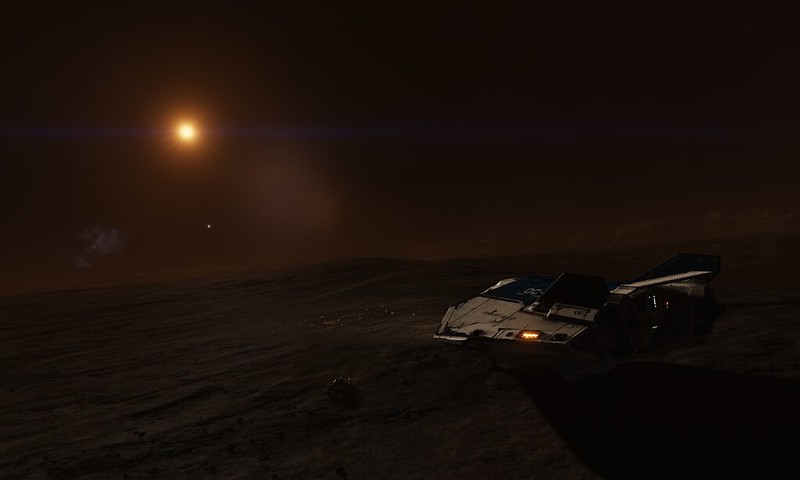
Yesterday, after the longest leg of the journey yet, I finally arrived. There weren't any neutrons along the way to shorten the amount of jumps. It was about 253 jumps this time. But I made it. I found the crater on Smootoae QY-S d3-202 3A, and almost ended my journey there when I got the boost while pointed down at the crater edge. I did quickly put full pips to systems and lowered my landing gear to absorb some of the impact. It knocked out my shields and damaged my Hull to 56%, but I survived.
I sent a message to the Hull Seals, and Cmdr Thorgal13 came out to perform the repairs I needed back to 100% hull. Thank you Hull Seals. Then a little while later, I met two other commanders I was able to chat with a while. Talked about some of our first computers and the early days of elite during that time. We friended each other and went on with our day.
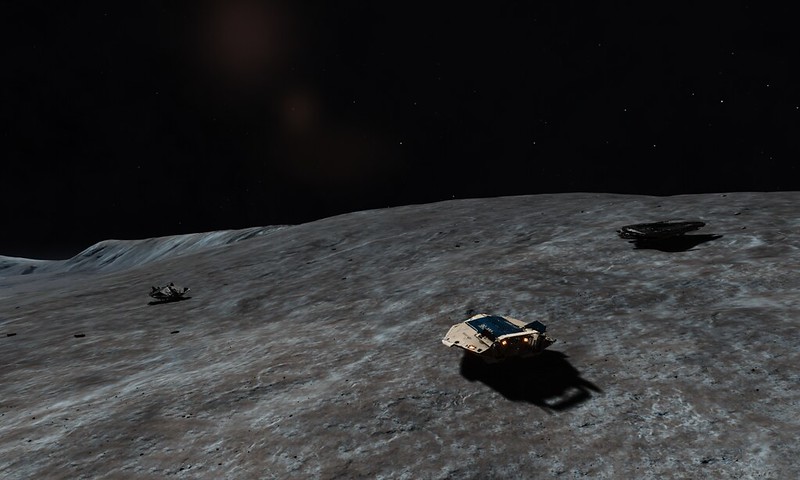
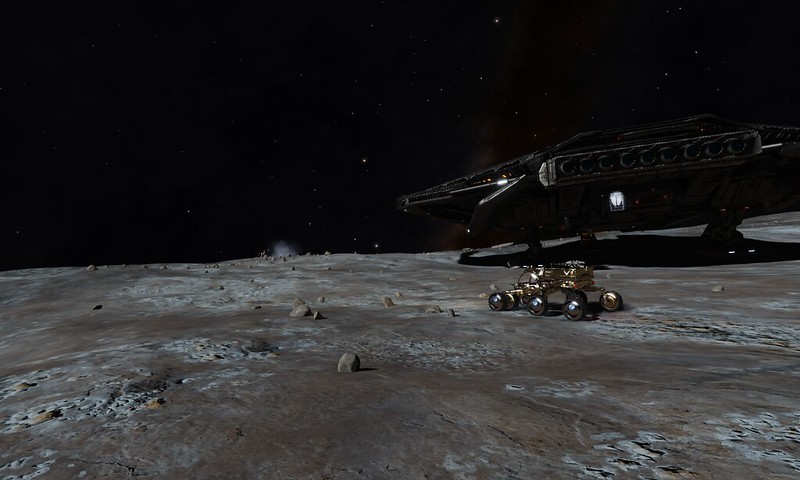
As I got closer to Waypoint 10 and the rest of the fleet, I did make a stop at a geological site of a planet I discovered, so I could take some more pictures of my trip. I didn't stay long because I was eager to say officially I'm with the rest of the fleet.
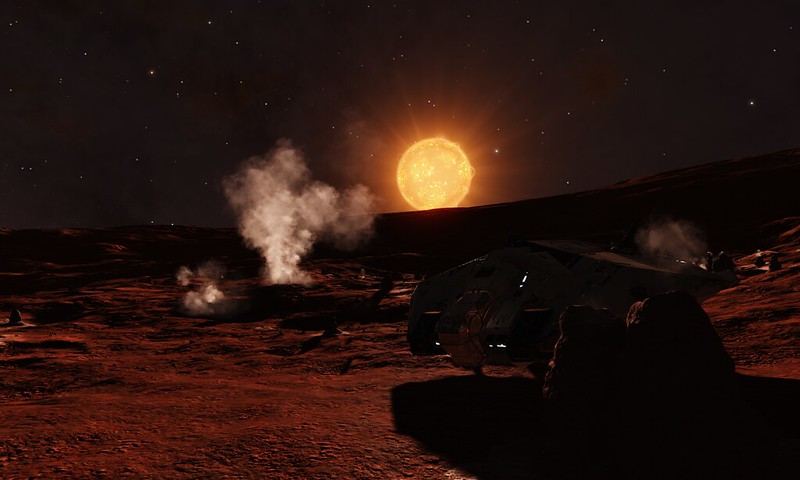

I made it to Waypoint 10 only a day before the fleet leaves for the next waypoint of the journey. As I arrived, I expected I would see a large number of people at basecamp, however there was no one there. I suppose they are all off doing things around the area, preparing for departure the next day.

Upon reaching the system Phroi Bluae QI-T e3-3454, I was instantly taken back by the color of the blue sky.
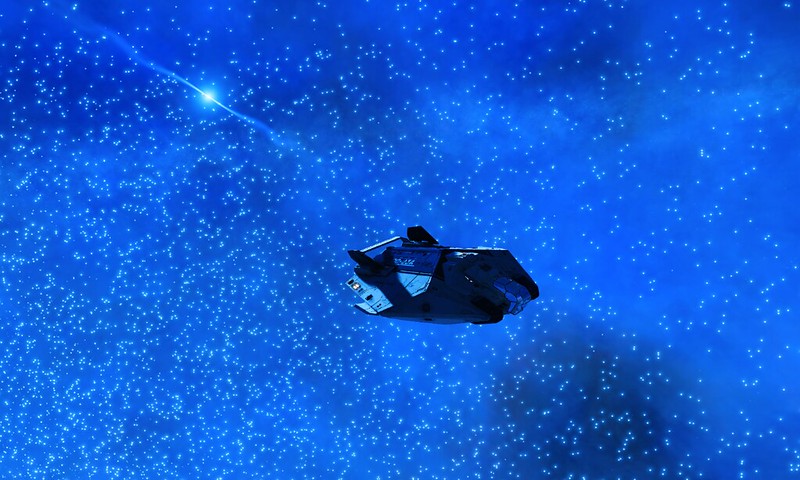
I found my destination at Tranquility Valley next to a ringed gas giant. Only stopping here for a short time before continuing on. The fleet is just ahead and shouldn't be moving on for another few days.

This was the longest distance of the journey so far, but I made it. There was no landmark to really know where the basecamp was, so I flew around using the Lat/Lng until I found it. After landing, I instantly recognized what I've seen in pictures from the others.
Being this close to it's sun, makes you feel good to rest in it's warm rays. I feel like I'm actually gaining some ground on the rest of the fleet. I should catch up by the weekend. For tonight, I'll just enjoy and relax in the sun.

